Mass Drag
on Campus
"Five drag nuns. One gay bar. A thousand years of queer history the Church would rather you not know about."
A world-premiere musical about faith, belonging, and institutional change — as relevant to a theology classroom as a gender studies seminar, a queer studies colloquium, or a theater department stage. Two formats, built to fit a class period, a colloquium, or a full community event.
Mass Drag isn't a novelty booking. It comes from a former Jesuit candidate and Harvard-trained theologian who spent decades as a Catholic cantor, and it draws just as directly on queer history, performance theory, and musical-theater craft — already generating exactly the kind of two-hour conversation a class period rarely gets on its own.
| Format | Staged ritual / musical theatre — one act, no intermission |
| Cast | 5 performers + Music Director |
| Runtime | ~60 minutes (Fringe edition) · ~90 minutes (full-length) |
| Tech | Minimal — flexible staging, fast load-in/out · 15-minute turnover ready |
| Audience | LGBTQ+, progressive faith communities, downtown theatre |
| Premiere | Biltmore Bar and Lounge, Rochester Fringe Festival, September 2026 |
Two Ways to Bring It In
Happy to work within grant parameters and departmental budgets, especially for a first collaboration.
Fall dates are filling in around the Sept. 15–18 premiere run — worth reaching out soon if you're hoping to schedule this academic year.
From the Table Read
March 2026 — 20+ participants, standing ovation, two hours of discussion afterward.
Mass Drag resonates with everything we're doing: how we've been trained to accompany people through life's struggles, how Gen Z and beyond are alchemizing the hidden queer histories of faith into something new — the work is real, vital, and deeply encouraging. May we listen well to the queens in our midst!
Chaplain, Rochester Institute of Technology's Progressive Chapel Community
Planning Questions, Answered
Where Things Stand
- World premiere confirmed — Sept. 15–18, 2026, ESL Rochester Fringe Festival, the Biltmore.
- First campus engagement booked — Hobart and William Smith Colleges, Nov. 5, 2026.
- Fiscal sponsorship through Fractured Atlas, plus a Rochester Fringe Production Launch Fund grant.
The Trajectory
Rochester is where the show gets built. New York is where it gets recognized.

Blessed Sister Donna Wanna-Noh · Sisters of the Blessed Canon
From the Score
Selected Tracks — Demo Score
Full score — all 10 songs — available upon request.
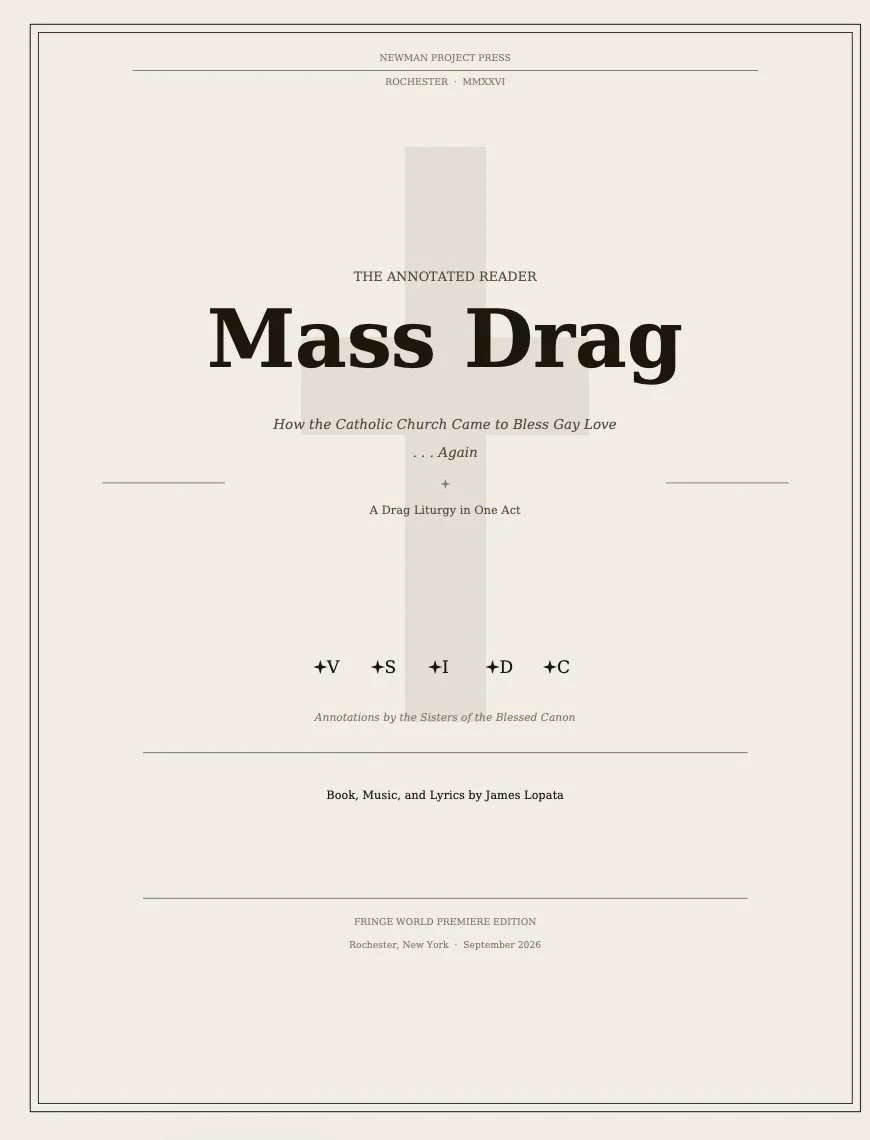
The Annotated Reader
Newman Project Press
Rochester · MMXXVI
Mass Drag: The Annotated Reader is a companion text to the show — equal parts theatrical script, cultural history, and academic resource. Designed for classroom use, it traces the documented and interpretive history behind every major claim in the production, distinguishing clearly between what is verified, what is interpretive, what is historically disputed, and what belongs to the mythology of the Sisters of the Blessed Canon themselves.
From the Author's Preface
James Lopata opens the Reader with a short personal preface on why this history — the brother-making rites, the burnings, Newman's grave — needed a musical, not a lecture, and what he hopes a classroom does with that.
Six Original Essays — Potential Course Assignments
Each essay addresses a distinct historical and theological question raised by the show, and can be assigned independently or as a sequence.
-
Essay 1The Church Made Brothers: Adelphopoiesis and Brother-Making Rites An examination of the medieval Christian rite of same-sex union — its liturgical form, its geographic spread across nine centuries, and the ongoing scholarly debate about what the ceremony meant to those who performed and received it.
-
Essay 2The Same Hands Burned: The Burning of Sodomites How the same institution that blessed same-sex unions came to criminalize and execute men for sodomy — and what that institutional continuity reveals about the relationship between theology, politics, and historical memory.
-
Essay 3Heart Speaks to Heart: Newman, Ambrose St. John, and the Theology of Love The life, love, and theological legacy of John Henry Cardinal Newman — his thirty-two-year relationship with Ambrose St. John, his motto Cor ad cor loquitur, and the question his canonization quietly leaves open.
-
Essay 4The Dig: The Surprising Exhumation of the Future Saint Newman, 2008 A close account of the Vatican's 2008 attempt to exhume Newman's remains from the grave he shared with Ambrose St. John — what they found, what it meant, and why the empty grave became one of the stranger footnotes in the history of Catholic sainthood.
-
Essay 5Again: Fiducia Supplicans and the Return of Blessing Two People of the Same Sex Pope Francis's 2023 declaration permitting the blessing of same-sex couples — its language, its limits, its reception, and the question Mass Drag asks of it: is this a breakthrough, or a homecoming to something the Church already knew?
-
Essay 6The Song That Cannot Be Unsung: Music, Liturgy, and the Theology You Carry Home Why the Vatican has scrutinized congregational lyrics more closely than almost any other form of catechesis — and how music functions as liturgy's most durable transmission technology, carrying theology into the body long after arguments from the pulpit are forgotten. Draws on Don Saliers and Josef Jungmann to make the case for why Mass Drag had to be a musical, not an essay.
Available now as a free advance PDF — both for your own consideration and, if you're willing, for your feedback before wider release. Paperback copies for course adoption, bulk orders, or classroom licensing available on request. Available on request — please use your institutional or organizational email so we can confirm and keep advance materials properly credentialed.

"I built Mass Drag because this history deserves a real hearing, not a footnote. I'd love to bring that conversation to your campus — reach out and let's talk about what fits."
- Studied playwriting with Nobel Laureate Derek Walcott, Boston University
- Master of Theological Studies, Harvard Divinity School
- Former cantor, St. Francis Xavier Church, New York City — a decade
- Music industry veteran — former Member of the Recording Academy, Grammy Voting Member
- Director, Drama League of New York
Start a Conversation
Every campus is different. Happy to talk through what fits your community, your calendar, and your budget — even a preliminary conversation is welcome. Available on request — please use your institutional or organizational email so we can confirm and keep advance materials properly credentialed.
Email Jim